%20(4115%20x%202362%20px).png)
Filing a County Court claim online is often quicker and simpler than issuing a paper claim. However, the online service is not suitable for every dispute and understanding its limitations before you begin can save time later.
Money Claim Online (MCOL) is HM Courts & Tribunals Service's online service for issuing many straightforward County Court money claims. Eligible claims can be completed online, the issue fee is calculated automatically and payment is made electronically.
Claims issued through MCOL must be served on a defendant with an address in England or Wales.[11]
HMCTS also provides the newer "Make a money claim" service, and the most appropriate online route depends on the type of claim you are bringing. [1]
Before issuing proceedings, try to resolve the dispute.
Send payment reminders and, where appropriate, a formal Letter Before Action explaining:
Courts generally expect parties to exchange information and consider settlement before proceedings are started. [8]
MCOL is designed for straightforward money claims where:
If your claim is more complex, requires detailed Particulars of Claim or is not eligible for the online service, consider issuing a paper Form N1 instead. [1]
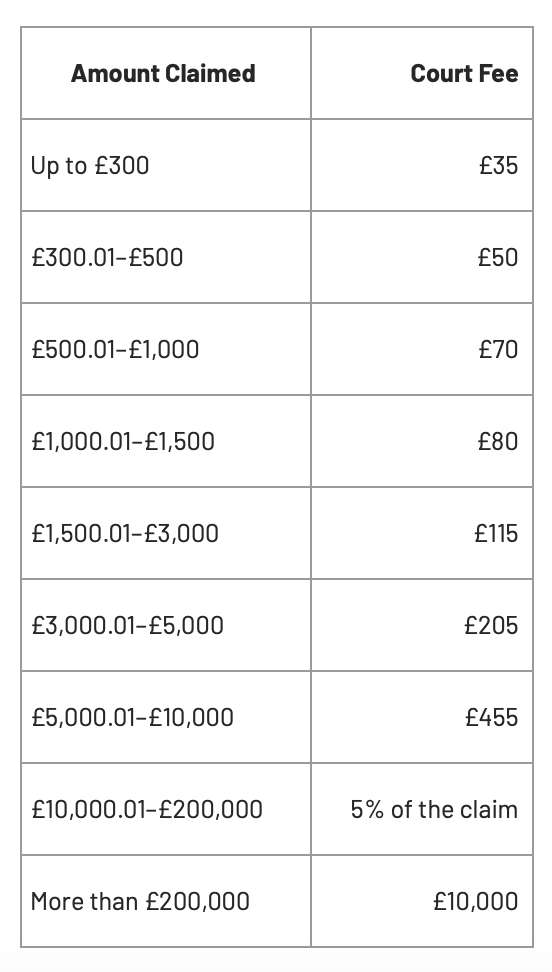
The issue fee depends on the value of the claim, including any interest claimed.
If you issue proceedings online, the system calculates the appropriate fee automatically. [2]
If paying the court fee would cause financial hardship, you may be eligible for Help with Fees.
However, you cannot use MCOL itself if you are applying for Help with Fees. If you qualify, you will need to use a different route to make your claim.[11]
The newer online money claims service allows you to provide a Help with Fees reference number when making a claim. Depending on your circumstances, you may also be able to make your claim using a paper form.[1][4]
For qualifying commercial debts, the Late Payment of Commercial Debts (Interest) Act 1998 generally allows suppliers to claim statutory interest at 8 percentage points above the Bank of England base rate. [9] [7]
You may also be entitled to claim fixed debt recovery compensation of:
If you wish to recover statutory interest or fixed compensation, include those amounts in your claim—they are not added automatically.
For defended money claims worth £10,000 or less, HMCTS will normally require the parties to participate in a free mediation appointment before the claim proceeds to a final hearing.
Mediation discussions are confidential. If no settlement is reached, the court claim continues through the normal process. [6]
For most straightforward contract claims, court proceedings must generally be started within six years of the cause of action arising.
If proceedings are started after that period has expired, the defendant may be able to rely on limitation as a defence. [10]
Obtaining judgment does not automatically result in payment.
If the defendant fails to comply with the judgment, you may need to apply for enforcement. Depending on the circumstances, available enforcement methods include:
Each enforcement method has its own procedure and court fee. [5]
For many straightforward money claims, issuing proceedings online is the quickest and most convenient way to begin a County Court claim. Before filing, make sure the claim is suitable for the online service, complete the relevant pre-action steps and include any statutory interest or compensation you intend to recover.
If your claim is complex or requires fuller Particulars of Claim, the paper Form N1 may be the more appropriate route. [1]
[1] GOV.UK, Make a court claim for money
[5] GOV.UK, Enforce a judgment
[6] GOV.UK, Resolve your claim through mediation
[7] GOV.UK, Late commercial payments: charging interest and debt recovery
[8] Civil Procedure Rules, Practice Direction – Pre-Action Conduct and Protocols
[9] Late Payment of Commercial Debts (Interest) Act 1998
Kwibble is a UK legal AI for SMEs, built around England & Wales law. We’re creating bespoke contracts, including NDAs and service agreements, plus tools to track key dates and obligations, send and sign documents, and manage everything in one place. Join the waitlist to get early access and help shape what we build.